



Spring
Brussels is one of the most beautiful capitals in Europe during spring. The change starts unobtrusively in March and hits its climax in May.
March
It is unpredictable in March in Brussels. You will have four seasons in a day as the locals say. There is a range of 4degC to 10degC and rainfall is also unpredictable. I have a small umbrella that I use throughout this month.
It is quieter in March. The Atomium and Manneken Pis offer smaller crowds, thus, a better photo and less congestion. Royal Greenhouses of Laeken are not open yet but also in preparation of opening in April.
The expectation is what makes March a good thing. Crocuses penetrate the earth in the parc du cinquantenaire, and cafe terraces begin placing the chairs outside. It is a promising start of the city to warmer weather.
April
The City of Brussels is brightest in April, and I personally like it as the month to tour the city. Temperatures also rise to a pleasant 8degC to 14degC, and the celebrated Belgian sunshine appears on a regular basis.
These Royal Greenhouses of Laeken are only open 3 weeks in mid-April/late April, a custom that runs back to 1876. This is really something special: grandiose Art Nouveau glass buildings with exotic plants, rare orchids, and century old palms. This is an event that locals put on their calendars and the tickets are sold in the shortest time possible.
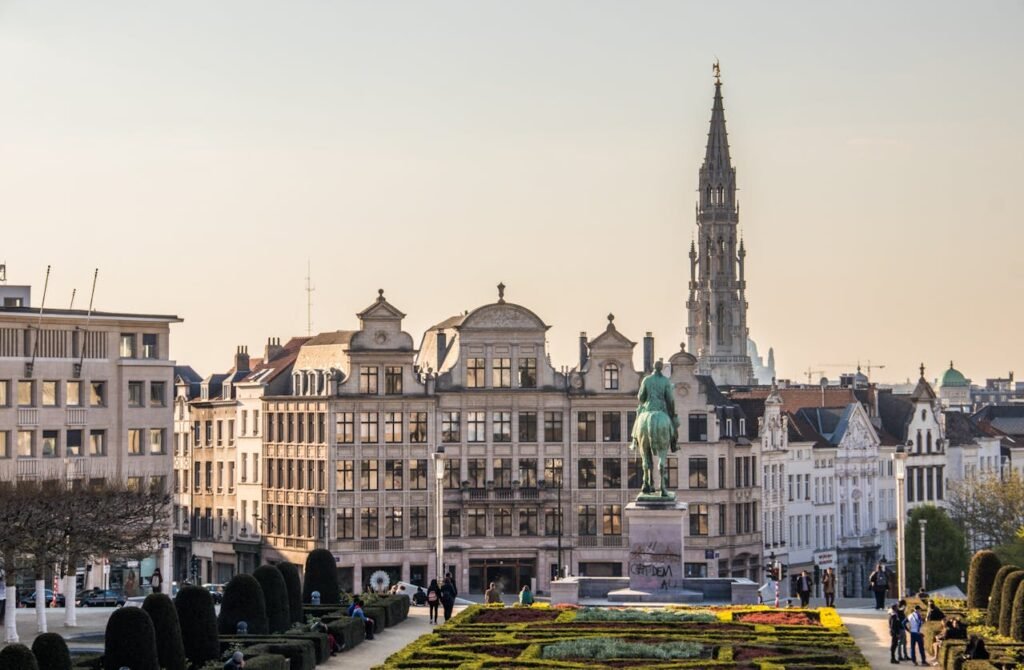
During April, cherry blossoms go off all over the city. The gardens in the Japanese Tower at Laeken and the walks in Avenue de Tervueren are covered in pink and white blossoms. Parc de Bruxelles, directly behind the Royal Palace, is planted with tulips in neat rows highly Belgian in their accuracy as well as loveliness.
The climate is unpredictable and therefore it is necessary to dress in layers. I usually have a light jacket in the morning which I can take off in the afternoon when the sun heats the cobblestones of the Grand-Place.
May
The weather is also the most certain during a day trip to Brussels in May with a high reaching 12degC to 18degC and a day that is longer until 9 PM. It does feel quite warm now with the sun, and they fill terraces with the locals who enjoy their first Jupiler or Leffe of the season.
By May the parks of Brussels are in blast. The Bois de la Cambre, a short way south of the city center, is an improved family and jogging place on weekends. In going between the Upper Town and the Lower Town you will go through gardens where roses are first opening their first flower and the air is filled with the smell of lilac.
The Brussels Jazz Marathon is a regular event that is usually organized on a weekend at the end of May and transforms the city into an open-air concert hall where people play in the bars and on the corners of the streets.
Spring Practicalities
In the warmer season (Spring, especially April and May), there are more visitors compared to the winter season but nowhere near the summer peak. The hotel rates go up by approximately 15-20 percent in comparison to the winter rates but they are still affordable.
Daylight Hours:
March: The sun rises at around 6.45 A.M. and sets at around 6.30 PM.
April: Sunrise 6.45 am Sunset 8.15 PM.
May: Sunrise 5.50 am and sunset 9:00 pm.
Summer
Brussels in Summer is not what northern European gloom would be. The city turns into a living room on the out of doors where you find the locals recapturing their every square meter of communal space, and the extended time of daylight that is available lengthens your visit to the city that will only last one day.
June
The month of June is, perhaps, the most suitable month to visit Brussels in case you would like to have the golden mean between the nice weather and the size of the crowds. Ranges of temperatures are 14degC to 22degC. Hot enough to wear shirts but cool enough to be able to walk around all day.
The city also enjoys music on the 21 st of June in the Fete de la Musique when one can find free concerts on the street corners, in the parks, and in the Marolles district.
The parks of Brussels are in their climax in June. In the rose garden of Parc de Bruxelles there are hundreds of varieties in full blast, and their smell hangs in the walkways in the late afternoon. The duck ponds in Parc Leopold are busy with people feeding ducks.
July
With temperatures reaching 16 deg C to 24 deg C, July is the hottest month of the year and reaches higher temperatures on the occasional heat waves. It is at this point that Brussels is fully devoted to summer mode. The city also refurbishes its open spaces with temporary art installations, open air cinema shows, and beach-like installations.
Brussels Beach (Bruxelles-les-Bains) is an annual event that is normally located along the canal in early July, but dates differ each year. Imagine sand, beach chairs, as well as outdoor bars and food trucks that will build a temporary seaside environment kilometers away from any ocean.
In July, the Grand-Place is even more spectacular as it has summer light shows where historical scenes and modern art are projected onto the gilded guild houses. I will always stay close to the center of the square to have the entire panoramic effect.

August
The temperatures are comparable to July 15 deg C to 23 deg C. But the city feels different.
Every even-numbered year, in mid-August, the Carpet of Flowers ( Tapis de Fleurs ) covers up the cobblestones of the Grand-Place – and an everyday marvel of 750,000 begonias in a huge carpet-work. Each edition has a different design that frequently has a theme of the Belgian culture or international festivals. When you come during this bi-annual event; come early (before 10 AM) or late (after 8 PM) to see it without having shoulder-to-shoulder crowds. The carpet does not last longer than four days, and hence time is of the essence.
Thunderstorms can occur suddenly during the afternoon of August. Heavy, violent rainfalls, flooding the roads within 30 minutes and then sunshine.
Autumn
Autumn shows Brussels at the best, at the most atmospheric and in my view, at the most beautiful. The city shrouds itself with gold light and copper-colored leaves, the masses are much less dense, and all is more personal and familiar.
September
Brussels has September as a secret weapon. A month of summer, without summer tourists. The weather is 12degC to 19degC, the light has that very autumnal quality, softer and more golden, which comes at a lower angle, and makes the gilding of the Grand-Place almost radiant.
September is still summery during the first two weeks. Cafe terraces are crowded, parks are green, and the tourist infrastructure is working according to the full summer schedules. However, the same cannot be said by the end of the second week when families are back on vacation, and Brussels is back to its working rhythm.
Belgian Beer Weekend is an annual event that usually takes place on the first weekend of September in the Grand-Place and turns it into a giant tasting salon with more than 400 Belgian beers. There are local breweries in place and by paying a small fee and a deposit on a glass, you can taste all the Trappist ales to experimental craft brews.
The change of summer into autumn occurs in the visible month of September. Even the vanes of profaneather, which overtake Avenue Louise, are already falling, and the walks in the mornings in Parc du Cinquantenaire show us already the first traces of yellow in the foliage. The air smells different too. Not so much summer heat on stone as an approaching rain and wet land.
October
It is in October that Brussels turns to amber and rust. The temperatures drop to 8degC-14degC and the trees in this city are very plentiful, horse chestnuts, maples, beeches burst forth in their full autumn color.
The Bois de la Cambre becomes a painting of the nineteenth century. The great beech trees make passages of gold and orange, and the rustling leaves are very pleasant to walk on. Although you may only spend one day in Brussels, a one-day tram ride to the borders of Bois de la Cambre (approximately 20 minutes out of the center) will give you an entirely different view of the city.
Parc de Bruxelles is more centralized behind the Royal Palace and it is easier to access autumn colors through the park. The straight lines of the paths bordered by the plane trees are perfect compositions of the leaves falling down on the gravel.
In October the mist and fog are restored, and particularly in the early mornings. In case you are in early morning person the Mont des Arts in the early morning at around 7.30 AM can be very atmospheric and almost empty. The upper terrace overlooking the spire of the Town Hall coming out of mist is truly magic. Bring your camera.
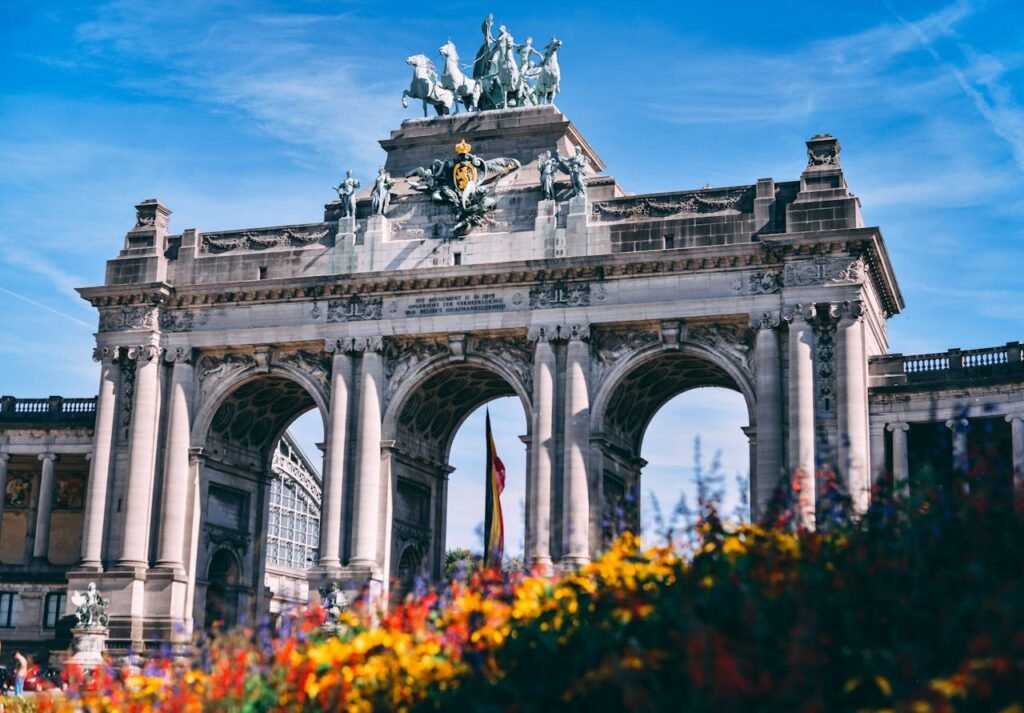
It picks up in the cultural calendar in October. It is especially fitting to visit the Brussels Art Nouveau heritage sites when the weather is changing such as the Horta Museum and the Cauchie House.
It is more in October than in September when there is an average of 12- 14 rainy days in October. And it is not all day long rain, rather, it is sporadic rains that pass by.
November
The temperatures lower to 5degC to 9degC and daylight is reduced drastically and gray skies are the order of the day.
It is the beautiful rain in November in the city. The medieval urban grid of the Ilot Sacre the web of streets around the Grand-Place is like entering a Bruegel scene when the fog is lying in the small alleyways.
The cafe culture reaches its peak in November. The Belgians retire inwards to their local cafes, and by going somewhere in Sainte-Catherine or the Marolles, as opposed to the Grand-Place quarter, which is overrun with tourists, you will get the live local life.
November is a month when museums in Brussels are especially attractive. There are hours of indoor entertainment in the Royal Museums of Fine Arts, the Magritte Museum, and the Musical Instruments Museum (including its amazing Art Nouveau building).
Winter
December
In December Brussels does become a northern European fairy tale. It is between 2degC and 6degC, there is the scent of mulled wine and roasted nuts in the air, and all of the city as a whole is lit up in holiday lights.
The winter wonders (Plaisirs d’Hiver) Christmas market usually lasts at the end of November up to early January filling various places between the Grand-Place and Place Sainte-Catherine to the Marche aux Poissons. The main installation is the Grand-Place one.
January
January is Brussels in its most genuine and the least touristy. During the first week, the Christmas markets wind up, the temperatures fall down to 1degC to 5degC and the city goes back to its regular beat. This month is the time to be in Brussels and feel like a local without the tourist Darwin crowds.
The after-holiday slump implies unbelievable value. Hotel rooms are covered with an all-time low of 40-50 percent discount on the prices that keep dwindling in the summer. January weather is gray. Not occasionally gray. Gray persistently, determinedly.
The art novouau cafes with their stained glass and polished wood interiors as in Le Cirio or Cafe Metropole are welcoming retreats that are worth the long afternoons with coffee and Belgian beer. The museums have the feeling of exploration as opposed to tourism. And even then absence of harsh sunlight renders photographing of buildings so good, the light is soft.
February
The weather is still cold with temperatures of 2degC up to 6degC and however, daylight is already starting to stretch as the month goes on. Towards late February, evening explorations are more possible, as the sunset is late after 6 PM.
But February has its moments. Brussels Chocolate Week is a yearly event that usually takes place during the month of February, but the specific months differ annually. The chocolatiers involved in the city hold tastings, workshops and special works.