


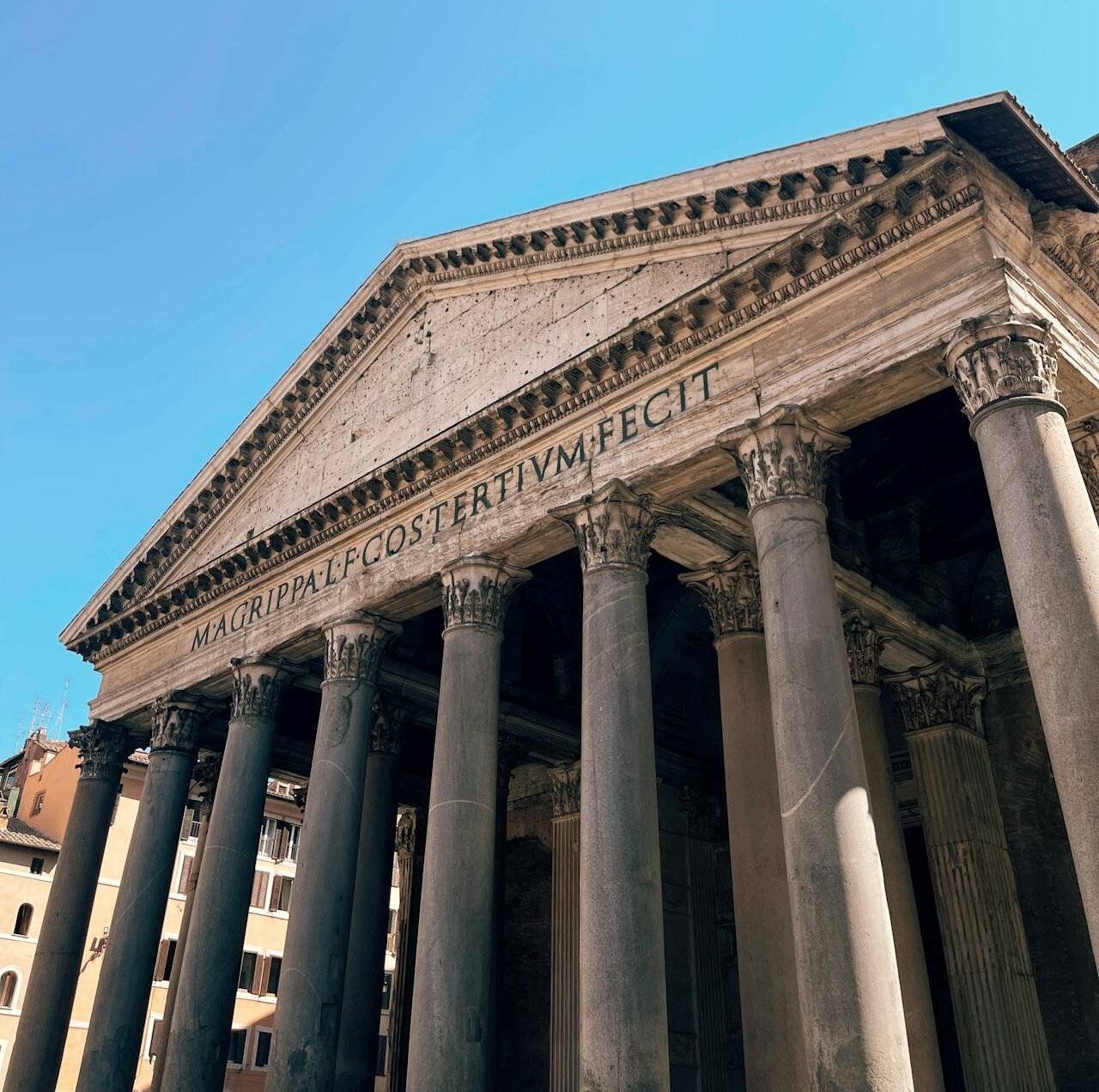
Located in the centre of Rome, the Pantheon has been almost 2,000 years old and is one of the most preserved ancient buildings in the world and a mandatory place to visit when one comes to the Eternal City. Its flawless dome, enigmatic sky-oil oculus, and a smooth union between pagan and Christian past makes this architectural masterpiece bewilder visitors ever since.
Whether you have one day or a week in Rome, whatever you see in this guide will give you the knowledge about the building, what to see both indoors and outdoors, the best times to go there, tips to use, places nearby, and the exact directions on how to get it. Let’s dive in.
Map
History of the Pantheon
In 27 BC Marcus Agrippa constructed the first temple at this site. Still the name of his name is to be read in the well-known inscription on the facade: “M·AGRIPPA·L·F·COS·TERTIVM·FECIT” (Marcus Agrippa, son of Lucius, made this when consul for the third time)
The same building was destroyed by fire in 80 AD and completely destroyed. The Pantheon was rebuilt at the time of 118-125 AD by Emperor Hadrian, it is the building we see today and it is astonishing. Hadrian retained the original inscription of Agrippa in a generous move.
Pantheon is a Greek name, which translates to all (pan) and gods (theos). It was initially a temple of all the Roman gods. The building technique is remarkable: the concrete dome is the largest unreinforced dome on the planet, which is 43.3 meters its record during more than 1,300 years.
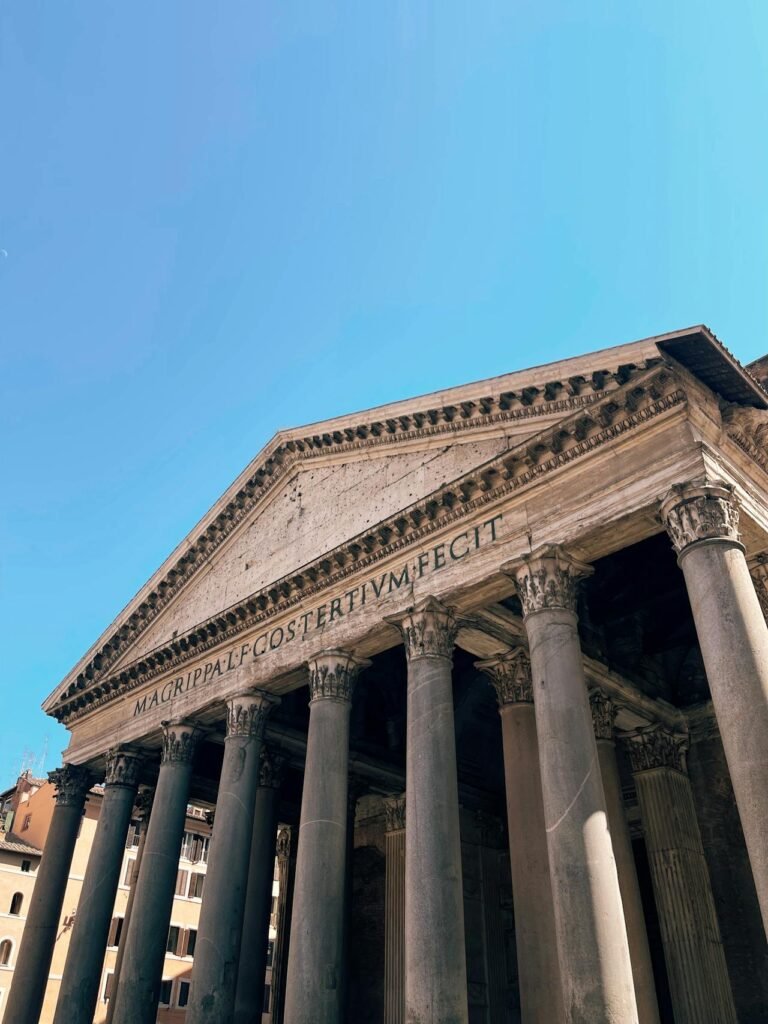
In 609 AD the Pantheon was transformed into a Christian church named as the Santi Maria ad Martyres (St. Mary and the Martyrs) by Pope Boniface IV. The building has survived in such amazing conditions due to this transformation which is the main factor that other Roman temples did not. In modern times it is used as a royal tomb the bodies of the Renaissance master Raphael and some of the Italian kings are there.
Inside
The Oculus
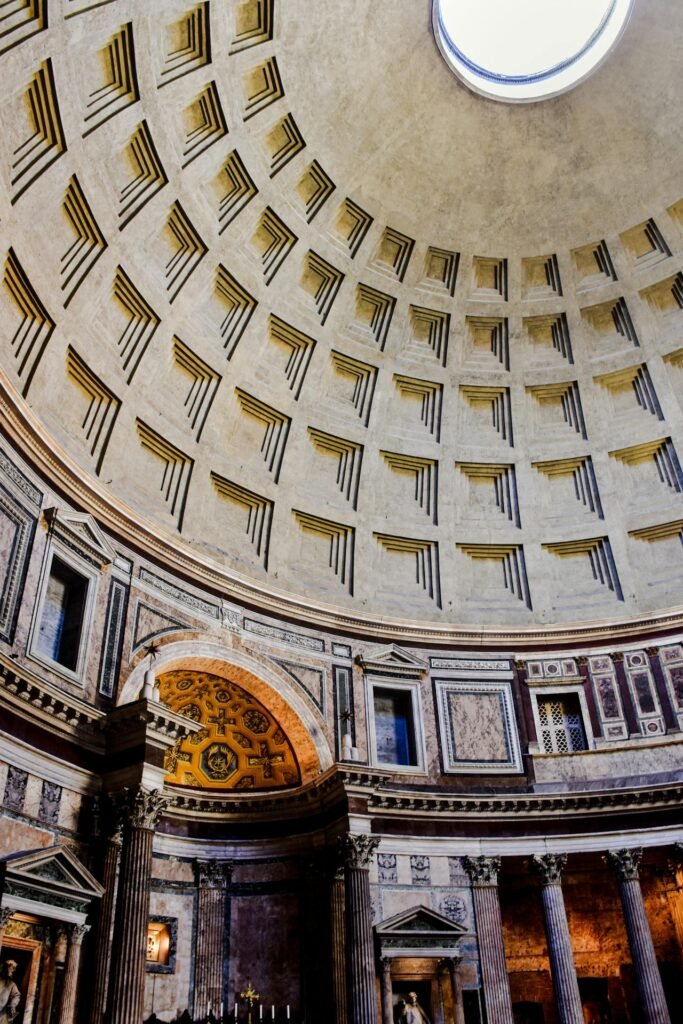
The Pantheon is best known by the oculus which is a 9-meter (30-foot) circular hole at the top of the dome. This is the natural lighting of this building, other than the doors of the entrances, and it produces a play of lights and shadows all day long.
It is true, it does rain through the oculus. Pantheon waterfalls when it rains in Rome. But smart Roman design implies it does not pond. The water is moved by the slightly curved floor as well as the 22 old drainage holes, the system which functions quite well even now, even after approximately 2,000 years.
Dome
The diameter of the dome is just the height between floor and oculus: 43.3 meters. This implies that a perfectly round sphere may fit within the interior.
Roman engineers accomplished this kind of engineering through a new type of concrete that was made up of volcanic ash and lime and pumice. The thickness of the dome is decreasing slowly at the base 6.4 meters to only 1.2 meters at the oculus.
Raphael’s Tomb
Among the most popular places within the structure of the Pantheon is the tomb of Raffaello Sanzio da Urbino, or Raphael, the master of Renaissance. He had died in 1520, at the early age of 37, and was interred here at his own wish. The Latin wording reads pathetically: Here lies Raphael, by whom Nature feared to be outdone while he lived, and when he died, feared that she herself would die.
Tombs of Italian Kings
Pantheon hosts the graves of Italian nobles such as king Victor Emmanuel II (the first king of the united Italy) and king Umberto I. The construction of their elaborate tombs indicates that they still had significance in terms of signifying the national identity of Italy.
The High Altar and Chapels
The central altar is icons of the Virgin and the child of Byzantine icon at the 7 th century. Seven chapels (known as aedicule) can be found around the circular interior, which presents the beautiful combination of pagan roots of the building and its Christian current state. Search in the works of the great artists and the different marble ornaments.
Pantheon Optimal Time to Visit
Most suitable hours: Early morning immediately upon opening (9.00 AM) or in the late afternoon (after 4:00PM). The place is not as crowded and the lights may be enchanted.
Worst times: Between 10:30 AM and 3:30 PM. This is the period when the tour groups overrun and queues are the longest.
How to Get There
The Pantheon is located in the very center of the historic Rome as it can be easily accessed on foot or by transportation.
- On Foot (Best Option)
From Piazza Navona: 3-4 minutes
From Trevi Fountain: 8-10 minutes
From Piazza Venezia: 10-12 minutes
From Spanish Steps: 12-15 minutes - By Bus
Nearest bus are at Largo di Torre Italy (a 5-minute walk), 30, 40, 62, 64, 70, 81, 87, and 492. Also you can alight on Corso/Minghetti to get lines along Via del Corso. - By Metro
The Pantheon does not have a metro station. The nearest options are:
Barberini (Line A) – approximately 10 minutes walking.
Spagna (Line A) – an approximate of 12-15 minutes walk.
Nearby Attractions
Piazza Navona: It is one of the most beautiful Rome squares with the excellent Fountain of the Four Rivers by Bernini. Good to people watch and street artists.
Trevi Fountain: The legendary baroque fountain is the best place to visit along with Pantheon. And make sure that you will come back to Rome by throwing a coin over your shoulder.
Campo de’ Fiori: It is a busy market square in the morning, a perfect place to have a lunch or an aperitivo in the afternoon. Trattorias are lavished around.
FAQs – Frequently Asked Questions
Not anymore. As of July 2023, they have admission fees on adults. Nevertheless, under-18s, the residents of Rome, and those who are on the first Sunday of the month are allowed to enter without charge.
The majority of the visitors spend 20-45 minutes indoors. When you are taken on a guided tour or take an audio guide, then estimate an hour. The outer and the piazza surrounding should be given an extra 15-20 minutes.
Yes! When it rains in Rome, the water passes through the 9-meter oculus. But don’t worry. The floor drainage system is that of ancient Romans and it is still effective today, draining the water.